
"Just some soft-minded, touchy-feely, new-age trend-of-the-decade?"
Mark Taylor and Christy Price were on our campus recently saying that lecturing is not the most effective way to teach. Some of us have bought into it while others are skeptical or outright hostile toward the proposition. I completely understand the skepticism. I earned three degrees mostly through courses based on lecture. Many of those lectures were captivating and informative (and I’d like to think I’ve delivered a few of those myself since then!). On the other hand, many of those lectures were a waste of time (not any that I delivered of course). Has something changed to make lecture-based learning an antiquated method? Or is this just some soft-minded, touchy-feely, new-age trend-of-the-decade that will disappear with time? And is it realistic to change how college courses are taught?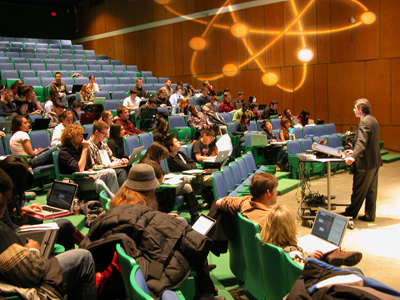 |
| Eric Mazur teaching his class at Harvard. (Photo: Emily Hanford) |
And this story makes the case further that lecture is not the best mechanism for instruction in most classes. "Students have to be active in developing their knowledge," says Hestenes. "They can't passively assimilate it."


I think we focus too much on delivery method. Like with dieting or longevity in life we all want that magic pill, vitamin, or food to fix everything. I am not convinced that method of delivery necessarily matters. In looking over my own college career, the exact manner in how a professor taught did not seem to matter in whether I liked a class and/or professor or how good I did with the material (grade, retention, applicability later in life). The teacher and subject mattered more. I am concerned at the push for homogeneity and conformity. When are we going to see an article, for instance, that praises lectures. There seems to be a bit of group think at work here.
ReplyDeleteYet, I do feel strongly that students need to be exposed to ALL kinds of teaching styles (but not all in the same class, though). We all learn differently (I did best with lectures, for instance.) Plus life outside of college does not cater to our styles, we adapt to it, so I think students having to adapt to different teaching styles can also be good. And by different professors offering differing styles, we over a semester or two will touch or inspire a student. In other words, if we all “flip”, then just as bad as if we all lectured. I feel energy, motivation, liking the students, etc. is much more important than the specific method in how one teaches (lecture, discussion, etc.) I fear the old fashioned lecture is becoming the whipping post for what is really just bad teaching (whether through lectures, activities, in person or online).
Some concerns in these articles—lack of comparative data, the focus on topics like physics and math, not history (I am bit biased there), the lack of distinction between intro level and upper level, and the lack of distinction between types of students and schools.
Okay, this is finally my main point. To me, other than professors, the main issue is student motivation. And I do not think that delivery method affects this. For instance, I deeply hated class activities and peer instruction. For me, they were just busy work. But really that all boiled down to my interest in the topic (and the professor). Some professors lectured, some did what we now are calling flipping the class (it really is not as revolutionary as these articles are making out). And whether or not I liked the class, learned the material, and/or was motivated to learn it and participate in the class was connected not to delivery method but rather to whether I cared about the class. While we professors cannot completely control that, I do believe that we play a huge role in fostering such motivation. In other words, we should strive to inspire the students to care about the topic/subject. If we succeed, then delivery matter won’t matter. Do not attack the method of the delivery of the message, rather attack the messenger (i.e., bad teaching whether through lectures or through flipping) and the message itself (i.e. not making it relevant for the students).
[For the record – I teach using lots of lectures but interspersed with class discussions, outside readings, in class writing, film clips, music, etc.]
You make some good arguments here Dave. I’ll respond to a few, but I hope others will pick-up on some of your other points.
DeleteIndeed, how well an instructor conveys enthusiasm for a subject and his/her ability to connect with students probably has a greater effect on student learning than a particular delivery method. I don’t think those who argue against the lecture are saying they should never be done, but instead, I think their point is that it should not be the primary, and certainly not the only, method of instruction. Delivering content via lecture is not teaching, they say. It is just that: delivering content. “Just because you said it doesn’t mean they learned it.” Effectively helping students do something with that content so that they truly “learn” it is their point. And that’s the whole point of flipping. They consume the content outside of class and then come to class where they do something with that content to more fully construct their knowledge and understanding of it.
You are right too that the basic concept of flipping is not brand new. “Read your assignment before coming to class,” is getting content outside of the classroom. However, I do think there are a couple of things happening with this idea that are new. First, technology is allowing us to deliver better content outside of the classroom than ever before. The ability to provide videos and even make your own is now possible along with other interactive applications. This allows students to view and review content over and over if need-be. Again, our technical ability to provide those experiences is very different than it ever has been. Second, the flipping, or inverted, movement is all about active learning in the classroom. Students are exposed to the content on their own—outside of the classroom—and then do some “construction of knowledge” with it through active learning in the classroom. And there is a plethora of research on the effectiveness of this kind of learning.
You mentioned that you hated class activities as a student yourself. I’ve certainly endured some of them myself that I thought were pointless. The big gap for many instructors, I think, is how to do this active learning thing effectively. Just because students are in groups or doing some activity does not mean it is a good learning experience. A traditional lecture is preferable to a pointless, poorly-devised activity any day.
As you said, I do think approaches vary by discipline. Sometimes a well-delivered lecture is quite powerful—as certainly can be the case for your subject, history. The ability to connect with students as you are describing the persecution of a group of people by another is hard to replicate with a video. The question remains though, is this the best way to teach the entire subject?
--David Pollock
There is no "magic bullet" and one method of instruction will not work in all classes, but I do like what Dr. Mazur said at the end of the video, "you can forget facts but you can't forget understanding. I want them to understand the subject so they know it for the rest of their lives". That should be the whole idea behind teaching--to help our students understand the concepts in such a way they truly know it, not merely be able to recall it on a test or do it by rote. Just because most of us obtained our degrees by sitting through lectures and learned to adapt to lectures does not mean lecture is the best way to go. Lecture when done well works in some disciplines or topic/subjects but it doesn't reach all learners. There is no one size fits all with today's learner. As faculty we need to also adapt. We can't continue doing things the way we always have. If changing the way I teach helps students become more actively involved in their learning then maybe I'm the one who needs to learn to adapt.
ReplyDeleteIt's interesting reading the comments so far. I can completely relate to many things Dave said--there were certainly class activities that seemed like a complete waste of time to me when I was in college. Most of those, it seems, focused on group work with little direction, and we all know group work can be great or fall completely flat.
ReplyDeleteRegardless of whether or not we "flip" content, it seems like the idea of Active Learning is a good one. If nothing else--it seems like engaging with the students at certain points throughout a lecture would certainly keep them awake (not that any of us are boring! It's just hard to sit for over an hour without interacting.) It sounds like Dave has a lecture-based active learning approach already, which is great! I personally think there is nothing inherently wrong with lecturing. We just need to be aware of the different learning styles present in our classrooms as we teach.
I do plan to try to somewhat "flip" content in my chemistry class this spring. It will be a web-enhanced class, so I'll have the opportunity to have the students go over some material before coming to class. However, I also know that there will be a need for me to lecture some as well as give examples on the board, and I don't plan for the entire class period to be focused on completing guided assignments. But I do see the value in allowing time within class for students to complete some assignments--it really gives insight into whether or not a concept has been grasped.
I have enjoyed reading the posts of my colleagues. I see what Dave is saying about the lecture method being bashed, so to speak. I don't like the use of the word "eliminate" in the original post--too strong. I prefer to conceive the trend towards other methods as the exploration of other options, not the elimination of any of them--unless a method produces results that are contrary to course goals.
ReplyDeleteI believe that motivation is important, but the methods of achieving that motivation are crucial. Yes, it depends on the discipline in question, as others have said. In my math courses, mere telling is not totally effective because the student must do math in order to learn math.
I was concerned when our wonderful new ePodiums and computer labs came to us without link systems where we could turn off all computers from the front. I was used to introducing a topic with their undivided attention because of the power of a simple click!! Of course, I could demand that no computers be in use for my mini-lecture-- but one day I decided to try something. I did a mini-lecture while they had their MyMathLab pulled up. They listened to me, did problems, and asked questions almost seamlessly! It was a wonderful telling, working, and asking problem session. I was amazed at the nature of their multitasking skills! I don't know why I was amazed! I have grandchildren who can text, look at television, fix a sandwich, and talk to me simultaneously!
So, I call that a modified lecture. Does it work for all topics? No! There are topics where I tell them that a certain area may be a troublesome spot, so I have to "see the whites of their eyes"--at least for a little while.
We ask students to be active learners, so we must model that by being active educators. New methods not only energize students, but they also energize the professors. I teach many students who have worked all day and come to class in the late evenings and nights. I am constantly seeking ways to show energy from my direction so that they will use my energy to create their own.
The main point here aligns with what David Pollock said in his CTE purpose statement. As educators, we owe it to our students (and to ourselves) to be constantly seeking better ways and tweaking our craft.
We may come back to some things we've already done, but at least we continue looking.